VetraFi is a financial technology company, not an FDIC-insured bank. Banking services provided through our Banking Partner, Member FDIC.
Credit
Four easy payments is still debt: it just arrives in camouflage.
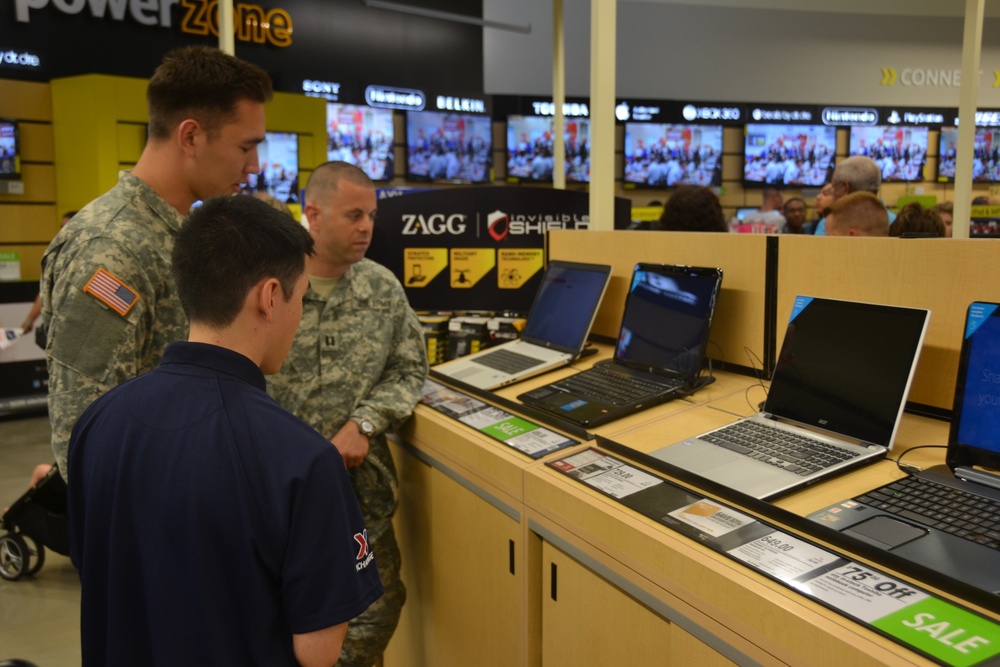
An Exchange associate assists two soldiers choosing a laptop at the Fort Belvoir, Va., main Exchange store. Photo by Lt. Col. Antwan Williams, Army & Air Force Exchange Service, DVIDS (public domain).
Upload your Leave & Earnings Statement and get a plain-English breakdown of every line.
Open LES Tool→Buy Now, Pay Later (BNPL) services like Klarna, Afterpay, and Affirm split a purchase into four or fewer installments, usually interest-free, approved in seconds at checkout. That's real convenience, and real debt with weaker guardrails than a credit card. Autopay can chain into overdrafts, plans stack faster than you notice, returns can leave you paying for merchandise you already sent back, and the legal protections you'd get with a credit card mostly don't apply. Meanwhile, the credit-reporting picture changed in 2025: BNPL activity is starting to show up on reports and in new FICO scores. Assume everything you do with BNPL counts.
The pitch is "split it into 4, no interest." Mechanically, a pay-in-4 plan takes 25 percent at checkout, then autopays three more installments every two weeks, usually after a soft credit check or none at all. Longer BNPL plans (six to 36 months, often with interest) run through the same apps.
Source: CFPB
BNPL's damage rarely comes from one plan. It comes from several small plans colliding with a checking account that wasn't watching.
If you can't buy it twice, don't split it into four.
Source: CFPB
In 2024 the CFPB issued a rule treating BNPL accounts like credit cards for dispute and refund rights, then withdrew it in May 2025 and said it won't prioritize enforcement. Practical translation: your dispute and refund protections are mostly whatever the provider's policy says.
Source: CFPB
For years BNPL was invisible to credit bureaus, quiet when you paid, quiet when you didn't. That changed.
Source: FICO / Affirm
Is BNPL bad?
Not inherently. One plan, sized to your budget, paid on time, costs you nothing. The mechanics (per-purchase approval, autopay, no consolidated statement) are just built to multiply quietly, and the fine print is thinner than a credit card's.
Does BNPL help me build credit?
Maybe, slowly. Now that providers like Affirm report to bureaus and FICO has BNPL-aware scores, on-time history can start to count. But if building credit is the goal, a secured card reporting to all three bureaus is the more reliable tool.
What if I already can't keep up with my plans?
Stop opening new ones today, then contact each provider about hardship options before payments bounce. Prioritize plans autopaying from your bank account to stop overdraft fees, and see a free installation financial counselor. This is exactly what they're for.
Free, trusted help is available:
VetraFi does not provide financial, investment, tax, legal, or accounting advice. The content provided is for informational purposes only. You should consult your own advisors before engaging in any transaction.
Earn It.
Important Disclosures
1. Banking Services. VetraFi is a financial technology company, not a bank. Banking services provided by First Bank of the Lake, Member FDIC.
2. FDIC Insurance. Deposits are held at First Bank of the Lake and are eligible for pass-through FDIC insurance up to $250,000 per depositor, per ownership category, if requirements for pass-through coverage are met. FDIC insurance applies only if the FDIC-insured bank fails.
3. Card Issuance. The VetraFi Shield Card is issued by First Bank of the Lake, pursuant to license from Mastercard International Incorporated. Cardholder terms and limitations apply. Mastercard and the circles design are registered trademarks of Mastercard International Incorporated.
4. Account Fees. The fees applicable to your accounts are disclosed in the respective account agreement for the account. Each of the account agreements are available at www.vetrafi.com/legal.
5. Credit Limit and Approval. The Shield Card is a secured charge card. Your credit limit is based on the amount of eligible funds in your deposit account and may increase or decrease as that balance changes. Funds securing your credit obligations are not available for withdrawal or transfer. Terms and conditions apply. See VetraFi Secured Charge Card Agreement.
6. APY. APY means Annual Percentage Yield. APY is accurate as of 09/15/2026. Minimum deposit required to open a Savings Account is $0. Interest rates and APY are subject to change at any time without notice. Fees could reduce the earnings on Saving Account. Funds must be held in Savings Account to earn interest. Other terms apply. See VetraFi Savings Account Agreement for details.
7. Early Access to Direct Deposit. Early access to direct deposit is available for eligible account holders that set up a direct deposit with their employer or paying agency. Early access to direct deposit funds is subject to when First Bank of the Lake receives notice of payment from the payer, which is generally one to two days before the scheduled payment date. Early access to direct deposit funds is not guaranteed, may be stopped at any time, and may vary between pay periods. Direct Deposit is only available for the Secured Deposit Account. Terms and conditions apply.
8. ATM and Fee Policy. VetraFi does not maintain a fee-free ATM network. Your card can be used at any ATM where Mastercard is accepted. ATM operators may charge a fee for cash advances. VetraFi will reimburse up to $15 per month or 4 fees per statement cycle for eligible fees; limits and conditions apply.
9. Non-Advice. VetraFi does not provide financial, investment, tax, legal, or accounting advice. The content provided is for informational purposes only. You should consult your own financial, investment, tax, legal, and accounting advisors before engaging in any transaction.
10. ATM Limits. ATM cash advance limits apply. See Secured Charge Card Agreement for details.
11. Account Terms. This Shield Card Account is opened together with a separate Secured Deposit Account and a Savings Account. See agreements available at www.vetrafi.com/legal for full terms and conditions.
12. Autopay. Autopay enrollment authorizes automatic payments from your Secured Deposit Account to pay the Shield Card balance due. You remain responsible for ensuring sufficient funds are available in the Secured Deposit Account and for making any required payment if autopay is not completed.
13. Credit Inquiries. Opening a VetraFi account does not result in a credit inquiry. Your Shield Card credit limit is based on the amount of eligible funds in your deposit account, not on a review of your creditworthiness. To open an account we must verify your identity, which may include obtaining information from consumer reporting agencies. Account opening is subject to identity verification and approval. Terms and conditions apply.
14. Subject to Approval. Products and services offered through VetraFi are subject to approval. Terms and conditions apply. See agreements available at www.vetrafi.com/legal for full terms and conditions.
15. Mastercard Zero Liability. You will not be held responsible for unauthorized transactions, including purchases made in store, by phone, online, or via mobile device, and ATM transactions, provided you used reasonable care in protecting your card from loss or theft and promptly reported any loss or theft to us. Zero Liability does not apply to certain commercial cards or unregistered prepaid cards. More information can be found at mastercard.com.
16. Third-Party Trademarks. All third-party trademarks, service marks, and logos are the property of their respective owners and are used for informational purposes only; no endorsement is implied. APPLE and the Apple logo are trademarks of Apple Inc. GOOGLE PLAY and the Google Play logo are trademarks of Google LLC. Mastercard is a registered trademark of Mastercard International Incorporated. Plaid is a trademark of Plaid Inc.
17. Non-Endorsement. The appearance of U.S. Department of Defense visual information does not imply or constitute Department of Defense endorsement.









Comments
Share your experience or ask a question. Comments are reviewed by our team before they appear.
Leave a comment