Financial Readiness
The handful of terms that decide what a loan really costs you.
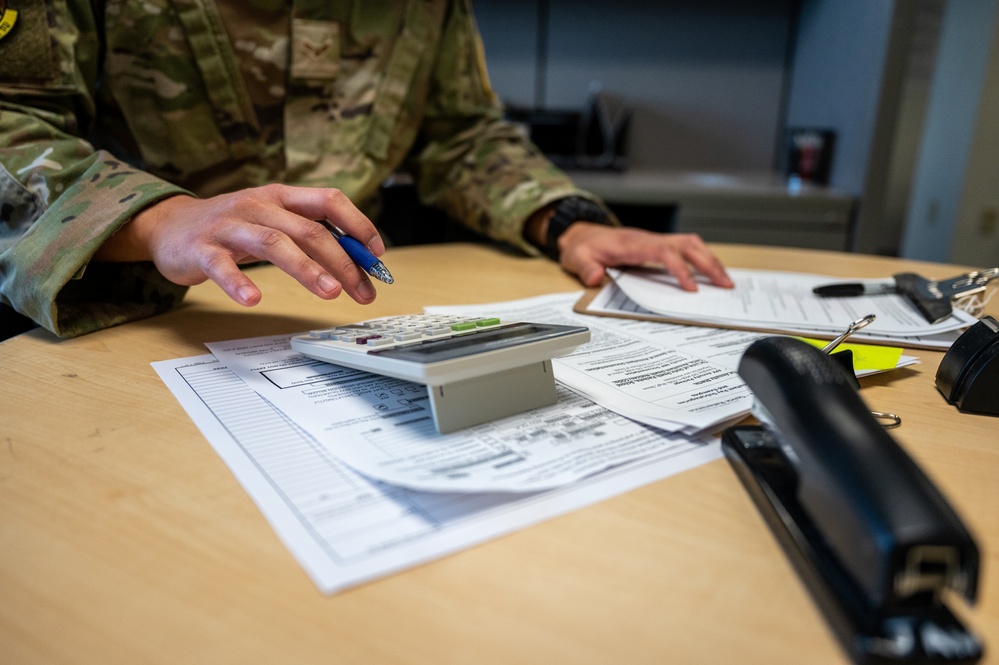
A finance Airman works through paperwork with a calculator, Patrick Space Force Base, Fla. U.S. Space Force photo by Airman Collin Wesson, DVIDS (public domain).
Upload your Leave & Earnings Statement and get a plain-English breakdown of every line.
Open LES Tool→Every loan comes down to three numbers. The principal, which is the amount you borrow. The interest rate, which is what the lender charges you to borrow it. And the term, which is how long you have to pay it back. Get those three straight and no loan can sneak up on you.
One more number ties them together. The APR is the interest rate plus the lender fees, shown as one yearly figure. It is the number to use when you compare offers. And the rate comes in two flavors: a fixed rate stays put, while an adjustable rate can move.
Principal, rate, and term set the price of any loan. APR ties the rate and fees together so you can compare offers fairly. Here is how each piece works, and how term shapes the trade-off.
Longer vs shorter term
Compare APR to APR, not just the interest rate.
Source: CFPB
The term is how long you have to pay the loan back, and it drives a trade-off. A longer term means a lower monthly payment but more interest over the life of the loan. A shorter term means a higher payment but less interest. The longer you stretch it, the longer interest keeps stacking on the balance that is left.
The interest rate is the cost of borrowing the principal. The APR is that rate plus the lender fees, like origination charges, shown as one yearly percentage. Compare two loans by APR, because a lower interest rate with heavy fees can cost more than a higher rate with none.
Amortization means paying down the balance with regular payments over time, so what you owe drops with each one. Early on, more of each payment goes to interest. Later, more goes to principal. That is why paying extra early, when the balance is largest, knocks down the most interest. One caution: some loans do not fully amortize, which can leave a balance owed even after the scheduled payments end.
A fixed rate is set when you borrow and stays put. An adjustable rate often starts lower, then resets on a schedule. In a life that already moves, a payment that can move too is worth a hard look before you sign.
Fixed rate: Set when you borrow. The payment stays the same the whole time, which makes it easy to budget.
Adjustable rate: Often starts lower, then resets on a schedule. After the intro period the payment is likely to rise.
Before you sign adjustable
An adjustable rate bites when rates climb past what your budget carries.
Source: CFPB
It can help when the lower starting rate makes the loan easier to qualify for, or when you expect to pay the loan off before the rate resets. It works against you when rates climb and the payment jumps past what your budget can carry.
You do not have to size up a loan on your own. Every active-duty, Guard, and reserve member, and their family, can sit down with a Personal Financial Counselor at no cost to walk through loan offers before signing. Your installation personal financial manager can do the same. For plain-language explainers on rates, APR, and amortization, see the CFPB. All three are linked in Sources below.
Which is cheaper overall, a fixed or adjustable rate?
It depends on where rates go and how long you keep the loan. An adjustable rate may start lower, but the payment can increase a lot after the intro period.
Should I just pick the loan with the lower interest rate?
Not on its own. Compare APRs, since the APR includes lender fees the interest rate leaves out.
Does paying extra early actually help?
Yes. With an amortizing loan, the balance drops with each payment, so extra payments early cut the interest that would have stacked on that balance.









Comments
Share your experience or ask a question. Comments are reviewed by our team before they appear.
Leave a comment