Financial Readiness
The base insures the building, not your gear. What renters covers, and why it's cheap.
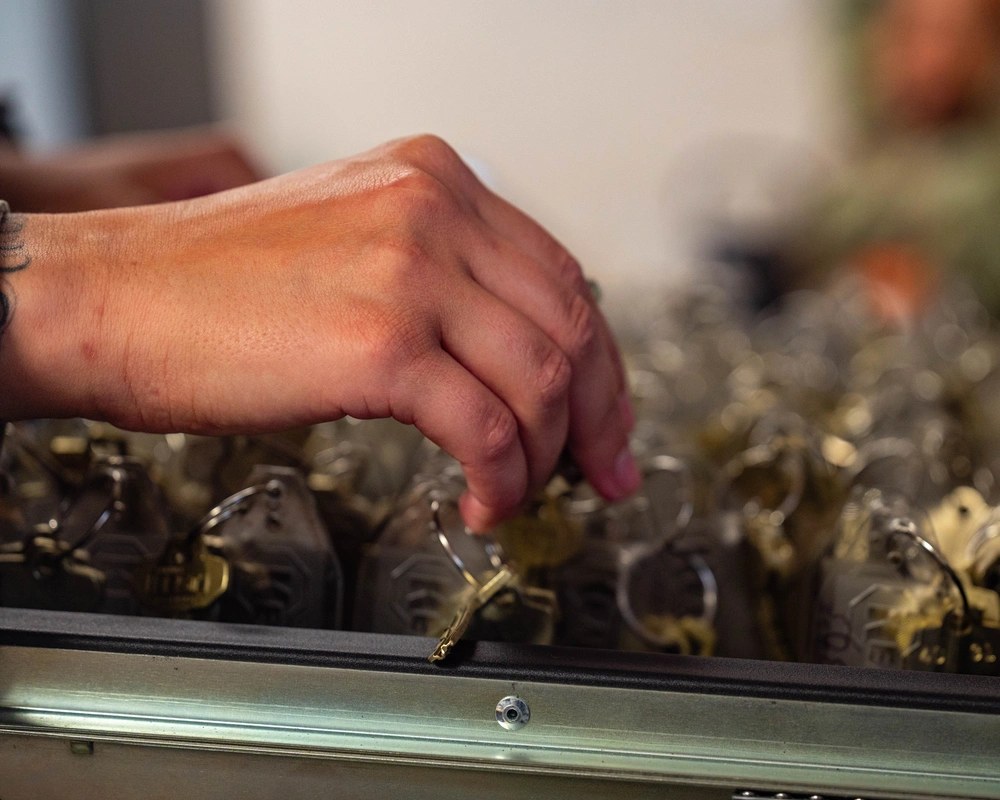
An Airman dorm leader grabs a key to a dorm room, Luke AFB, Sept. 3, 2025. U.S. Air Force photo by Airman 1st Class Tekorey Watkins, DVIDS (public domain).
Upload your Leave & Earnings Statement and get a plain-English breakdown of every line.
Open LES Tool→Renters insurance covers your belongings, not the building. If the barracks burns or floods, the military rebuilds the structure. It does not replace your laptop, your clothes, or your gear inside.
A policy is cheap, often $15 to $30 a month, and it also covers you if you injure someone or damage their place. Check whether your housing already includes any coverage first, then get a quote.
Renters insurance is the policy that covers your stuff and your liability. It is one of the cheapest pieces of financial protection you can buy, and it fits how military life moves.
$15 to $30
a month for about $30,000 in property and $100,000 in liability coverage.
If the barracks burns, the military rebuilds the building. You do not get your laptop back.
What it covers
Source: Military OneSource · figures illustrative
It is not required by law, though a landlord or housing office may require it. The reason it matters is simple: the government insures the structure, not your personal property. If the building burns or floods, the military rebuilds it. You do not get your kit, your clothes, or your electronics back from that.
Because it insures your belongings, not a building. A common policy runs about $15 to $30 a month for roughly $30,000 in property coverage and $100,000 in liability coverage. The price depends on location, deductible, credit, and past claims. A deductible is the amount you pay before coverage kicks in. That is a tank of gas a month against the cost of replacing everything you own.
As a rule, no. The government covers the building, not your possessions. Even in privatized housing, the company's policy usually covers the structure, not your gear inside it. Some privatized-housing coverage only applies after your own policy pays, and only for big losses. With no policy of your own, you are on the hook.
Living on an installation does not mean your stuff is covered. Read what the housing policy actually does, then close the gap with your own.
The gap: Some privatized-housing coverage only applies above a high threshold (for example over $10,000) and only after your own policy pays. No policy of your own leaves a real gap.
Check before you buy
Replacement cost pays for a new item; actual cash value pays the depreciated value.
Source: Military OneSource · NAIC · figures illustrative
You do not have to sort this out alone. Start with your housing office to confirm whether a policy is required and what your housing already covers. Military OneSource explains renters insurance basics for service members. Your state insurance department can help you understand coverage terms and compare. Installation legal assistance is free if you hit a landlord or claim dispute. All of these are named in plain text, with links in Sources below.
Do I need renters insurance in the barracks?
It is not required by law, but the military does not insure your personal property. Without it, you would pay out of pocket to replace your gear after a fire, flood, or theft. Check whether your housing includes any limited coverage first.
How much is it?
Often $15 to $30 a month for about $30,000 in property coverage and $100,000 in liability, depending on location, deductible, credit, and claims history. These figures are illustrative.
Does it cover my stuff during a PCS move?
Often, yes. Many policies continue coverage as you move your military household goods, though the details vary. Confirm the terms with your insurer before you ship.







Comments
Share your experience or ask a question. Comments are reviewed by our team before they appear.
Leave a comment