Thrift Savings Plan
New in 2026: move pre-tax TSP money to Roth, pay taxes now, and grow it tax-free.


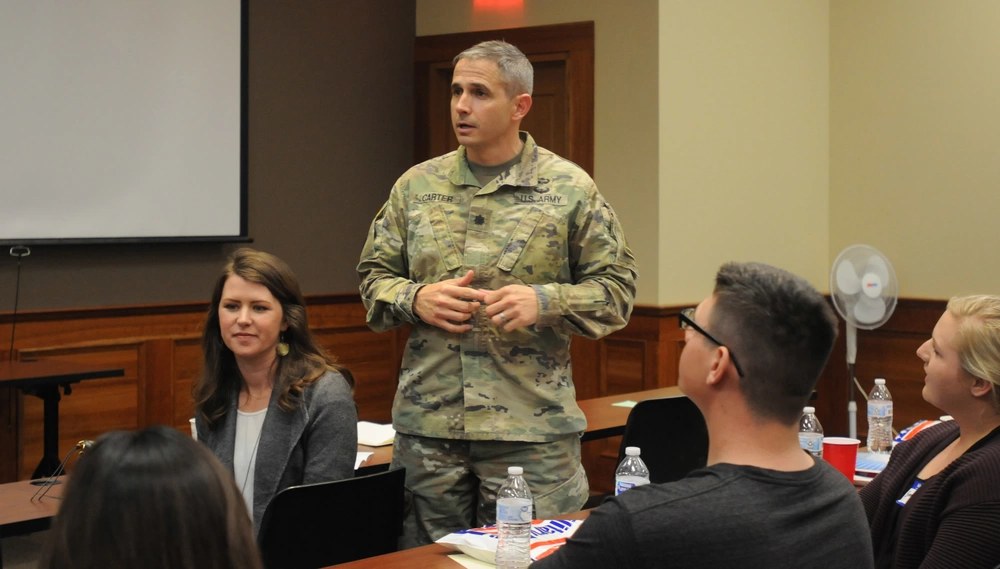
Army and DFAS financial management leaders at the 2026 U.S. Army-DFAS Financial Management Workshop, Indianapolis, Indiana, May 12, 2026. Photo by Mark R. W. Orders-Woempner, U.S. Army Financial Management Command. Public domain via DVIDS (VIRIN 260512-A-IM476-1679).
Upload your Leave & Earnings Statement and get a plain-English breakdown of every line.
Open LES Tool→Starting January 2026, TSP participants can convert traditional (pre-tax) TSP money to Roth (after-tax) money without leaving the TSP. You pay income tax on the amount you convert in the year you do it, but the money then grows and distributes tax-free for the rest of your life. The conversion is permanent and cannot be reversed, so it pays to think this through before you act.
The biggest opportunity is for service members deployed to a combat zone: tax-exempt pay you contributed to your TSP converts to Roth without triggering any federal income tax at all. Outside of deployment, converting makes the most sense when your current tax rate is lower than what you expect to pay in retirement.
Your TSP can hold two types of money: traditional (contributed pre-tax, taxed on withdrawal) and Roth (contributed after-tax, grows and withdraws tax-free). Until 2026, you could switch how you contributed going forward but you could not move a pre-existing traditional balance into Roth. Now you can, using a Roth in-plan conversion.
This is different from contributing to the Roth TSP or opening a Roth IRA. You are moving money you already have in your traditional balance over to the Roth side. No contribution limits apply, and you do not have to wait for separation or any other qualifying event.
A Roth in-plan conversion cannot be reversed or changed. Once you convert, that decision is final.
The amount you convert is added to your ordinary taxable income for the year you convert. If you convert $20,000, the IRS treats that $20,000 as income on top of your regular military pay. That can push you into a higher bracket or significantly raise your April tax bill.
There is one critical rule: you must pay the tax bill from money you already have outside the TSP: a savings account, checking account, or other funds. You cannot use any portion of the converted TSP money to cover taxes. If you do not have the cash set aside to cover the tax, converting is the wrong move right now.
If you contributed to your TSP while deployed to a qualifying combat zone, some of your traditional TSP balance is made up of tax-exempt pay. The TSP tracks this separately. When you convert those tax-exempt dollars to Roth, you owe no federal tax on that portion; the exclusion carries over to the conversion.
Example: You have $80,000 in your traditional TSP, of which $30,000 came from combat-zone contributions. You convert $80,000 (leaving the $500 holdback). The $30,000 of tax-exempt money converts tax-free. The remaining $50,000 is added to your taxable income for the year. Going forward, 100% of that converted amount grows and distributes tax-free in retirement.
This makes a Roth in-plan conversion especially valuable for service members currently deployed or recently returned who still have tax-exempt money in their traditional TSP.
Converting makes sense when you expect to be in a higher tax bracket in retirement than you are right now. Several situations point that direction:
Converting makes less sense if you are in a high bracket now and expect lower income in retirement, or if you do not have outside cash to cover the tax bill without financial strain.
Sources: TSP.gov: Roth In-Plan Conversions · Soldier for Life: TSP Roth Conversions (April 2026) · TSP Booklet tspbk35: Roth In-Plan Conversions · DFAS: Combat Zone Tax Information