Investing
Don't put it all one place, and let the mix shift as you age. TSP Lifecycle does both.
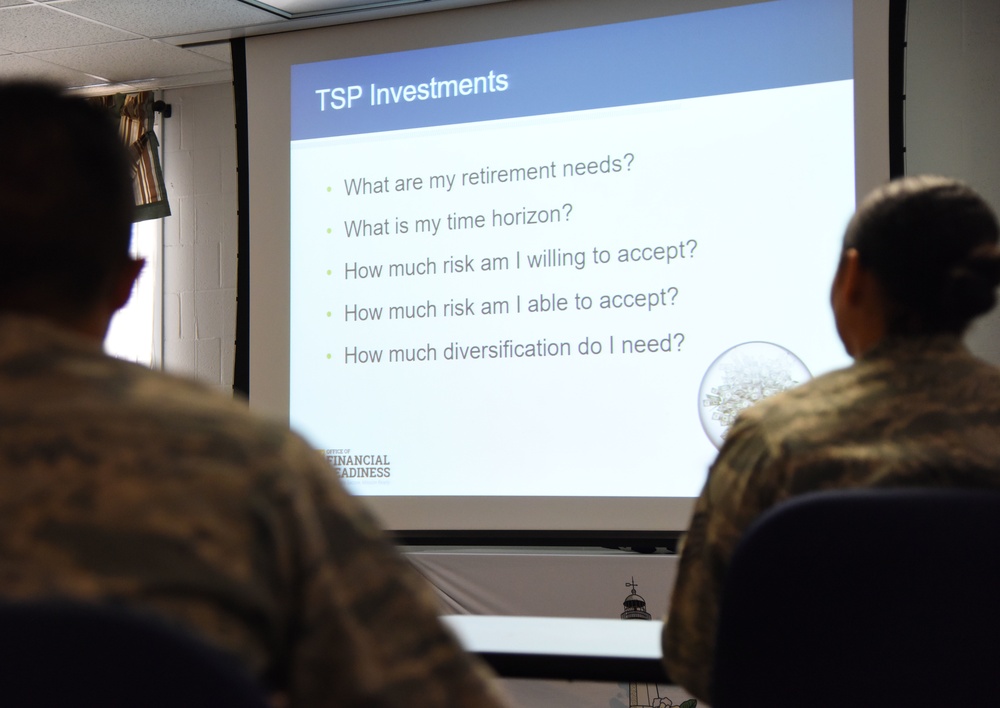
U.S. Air Force photo by Kemberly Groue, Keesler Air Force Base, Mississippi, DVIDS (public domain)
Upload your Leave & Earnings Statement and get a plain-English breakdown of every line.
Open LES Tool→Two simple ideas drive most good investing. Diversification means do not put all your eggs in one basket: spread your money across many investments so one loss is cushioned by others. Asset allocation means how you split your money among stocks, bonds, and cash. Get those two right and you have done most of the work.
You do not have to manage the split by hand. Your Thrift Savings Plan (TSP), the military's retirement investment account, like a 401(k) for service members, has a built-in tool for this. A TSP Lifecycle fund, called an L fund, is a ready-made mix set to a target date. It diversifies for you and shifts the mix toward safer holdings as that date nears, with no extra fee beyond the low underlying costs.
Spread your money wide so no single holding can sink you, then let the stock-and-bond mix grow more conservative as your goal gets closer.
Two ideas
The L fund does both: The TSP Lifecycle (L) fund does both in one box: a diversified mix that glides toward conservative each quarter as the target date nears. No extra fee beyond the low underlying ratios (about 0.035% to 0.041% in 2025).
Pick the L fund with the target date closest to when you will need the money.
Source: Investor.gov · TSP.gov
Diversification means not betting everything on one investment. Investor.gov sums it up as do not put all your eggs in one basket. If one investment or sector struggles, others that are doing well can offset it.
You diversify on two levels. First, across asset types: stocks, bonds, and cash. Second, within each type: many different stocks across different industries, not four or five names. Owning a handful of individual stocks is not real diversification. A single broad fund, by contrast, can spread you across thousands of companies in one purchase.
Picture a fire team where everyone carries the same weapon and the same ammo. Lose that one supply and the whole team is stuck. Diversification is the fire team with mixed roles and mixed gear, so a single failure does not end the mission.
Asset allocation is dividing your investments among categories like stocks, bonds, and cash. It is the single biggest lever you control, because the three categories behave differently in different conditions. For many goals, a mix of stocks, bonds, and cash is a sound approach.
Allocation is about your timeline, not the day's headlines. The longer you have before you need the money, the more of it can sit in stocks chasing growth, because you can wait out the rough years. The closer you get, the more you shift toward bonds and cash to protect what you have built.
There is no single correct split, and your answer depends on your timeline and how much volatility you can stomach. A few principles hold up for most junior service members. With a long horizon, lean toward stock-type holdings, which in the TSP are the C, S, and I funds, since you have time to ride out drops. Add a bond fund (the F fund) for ballast, because stock funds plus a bond fund tend to be steadier than stocks alone, and that matters more as you age. Keep your emergency fund out of the mix entirely, in plain savings, so a surprise expense does not force you to sell. And shift gradually toward a more conservative mix as your goal approaches, rather than all at once.
If choosing percentages feels like guesswork, that is exactly the gap an L fund fills.
Each TSP L fund is a ready-made, diversified mix of the five core funds (G, F, C, S, and I), built so you can hold one fund and get an allocation matched to your timeline. You pick the fund with the target date closest to when you will need the money.
The L funds also do the age-based shift automatically. Every quarter, the target mix of each L fund (except L Income) is adjusted, gradually moving from higher risk and reward toward lower risk and reward as the target date approaches. The far-dated funds hold very little in bonds: no more than about 1% of the newest, longest-dated L funds sits in the G and F funds, with the rest in stock funds. As the date nears, the mix glides toward more G and F.
This is why new Blended Retirement System enrollees are placed in an age-appropriate L fund by default. It is diversification and allocation handled in one box, with no extra fee beyond the underlying funds' low expense ratios, which ran about 0.035% to 0.041% for the L funds in 2025.
You can let one fund handle the mix, or build and tend your own. Either path can work, and a handful of principles hold up no matter which you choose.
Pick your path
Principles that hold up
If choosing percentages feels like guesswork, that is exactly the gap an L fund fills.
Source: TSP.gov
Yes. You can spread your contributions across the individual G, F, C, S, and I funds in whatever percentages you choose. The trade-off is that you have to rebalance yourself over time. Rebalance means reset your mix back to plan, since some funds grow faster than others and pull your split out of line. An L fund handles that step for you on a set schedule.
You do not have to figure this out alone. You can compare target dates and allocations on the TSP Lifecycle funds page, read the principles behind allocation in the SEC's Beginners' Guide on Investor.gov, or sit down with your installation Personal Financial Manager or Personal Financial Counselor at no cost to match a mix to your timeline. You can also call the TSP ThriftLine for help changing your fund choices. All of these are linked in Sources below.
What is the difference between diversification and asset allocation?
Asset allocation is how you divide money among categories: stocks, bonds, and cash. Diversification is spreading out within and across those categories so no single holding dominates.
How should I split my investments?
It depends on your timeline and risk comfort, but a long horizon usually means leaning toward stock-type funds with some bonds for ballast. The TSP L funds set a split for you based on a target date.
Which L fund should I pick?
Generally the one with the target date closest to when you expect to need the money, often near your planned retirement age. A younger service member typically lands in a far-dated fund weighted toward stocks.
Do the L funds cost more because they are managed?
No. The L funds have no separate fee. You pay only the expense ratios of the underlying G, F, C, S, and I funds, which were about 0.035% to 0.041% for the L funds in 2025.









Comments
Share your experience or ask a question. Comments are reviewed by our team before they appear.
Leave a comment