Investing
Passive beats fancy for most investors thanks to one quiet force: fees, every year.
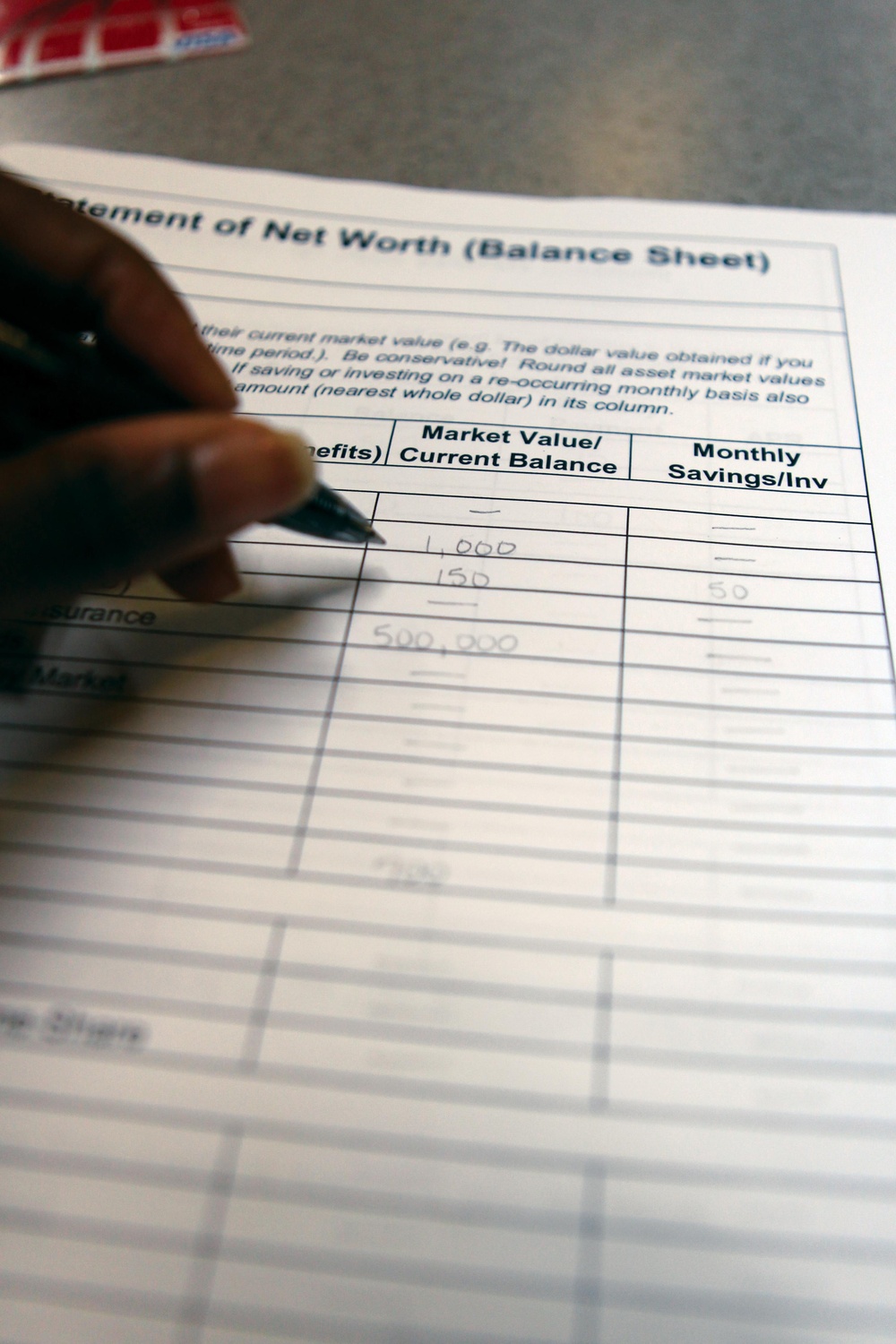
A savings and investment worksheet at a money management workshop, Okinawa, Japan. U.S. Marine Corps photo by Cpl. Jovane Holland, DVIDS (public domain).
Upload your Leave & Earnings Statement and get a plain-English breakdown of every line.
Open LES Tool→An index fund is a fund that holds the companies in an index and aims to match it, not beat it. The index is just a list, like the 500 large U.S. companies in the S&P 500. Instead of a manager guessing which stocks to buy, the fund simply holds what is on the list. An index fund can be a mutual fund, an ETF, or a unit investment trust.
That approach is called passive, which means the fund tracks an index. Less buying and selling inside the fund usually means lower trading costs, often friendlier taxes, and lower fees than funds where a manager is picking stocks. For most long-term investors, keeping a light hand on the wheel is exactly what you want.
One approach tries to beat the market and charges more for the attempt. The other just tracks the market at a tiny cost. For a set-it-and-forget-it investor, the low-cost route is a clean fit.
Two approaches
Why passive fits: You accept the market's return minus a tiny fee, and skip the risk of a manager who picks wrong. A clean fit for set-it-and-forget-it.
You cannot diversify your way out of a fee that is too high.
Source: Investor.gov
An active fund is not built around an index. A manager (active means a manager tries to beat the market) buys and sells holdings hoping to do better than the market, and the results lean heavily on that manager's skill. An active fund can beat its benchmark, and it can also trail it, and it usually charges more for the attempt.
Passive index investing skips the prediction game. You accept the market's return, minus a tiny fee, and you avoid both the higher costs and the risk of a manager who picks wrong. For a service member who wants to set it and forget it, that is a clean fit. You are not trying to call every shot. You are spreading across the whole market and letting the average do the work.
Because they do not take a day off. An expense ratio (the yearly fee a fund charges, shown as a percent of what you have invested) is charged every year, in good markets and bad. Investor.gov puts it plainly: over time, higher fees and expenses can lower investment returns. A fee that looks tiny as a percent can add up to real money across a 20 or 30 year horizon.
The TSP explains that a 0.035% expense ratio works out to about 35 cents for every $1,000 invested per year. Now compare that to a fund charging 1.00%, which is about $10 per $1,000. That 1.00% figure is only an example to show the scale, not a quote for any product. On a growing balance over decades, the gap between paying pennies and paying dollars per thousand compounds into a meaningful chunk of your retirement. Diversification still matters, but you cannot diversify your way out of a fee that is too high.
The fee is charged every year, on a balance that you hope keeps growing. A gap that looks like rounding error today compounds into real money over a career. Here is the same dollar amount seen two ways.
0.035% at the TSP: About 35 cents per $1,000 a year. Pennies, charged quietly in the background.
1.00% (an example): About $10 per $1,000 a year. On a growing balance over decades, that gap compounds.
Why it adds up
A fee that looks tiny compounds into a meaningful chunk of your retirement.
Source: TSP.gov · Investor.gov
Yes. The core stock and bond funds track indexes. The C fund tracks the S&P 500, and the F fund tracks a broad U.S. bond index, with the S and I funds tracking U.S. small-company and international indexes. They are passive by design, which keeps costs down.
The cost is where the TSP stands out. Its total expense ratios ran roughly 0.034% to 0.051% across the individual funds in 2025, and the TSP states its expenses are lower than 99% of investment options. For a service member, that means the index funds you would shop for on the outside are already sitting in your TSP at a price that is hard to beat. The lesson for an outside IRA is the same: when comparing funds, the expense ratio is one of the first numbers to check.
What is an index fund?
A fund that holds the companies in an index and aims to match it, not beat it. That passive style keeps trading and fees low.
Active or passive, which is better for me?
Passive index funds tend to carry lower fees, and lower fees help returns over time. Active funds may beat or trail the market and usually cost more. VetraFi cannot tell you which to pick, but cost is a major factor for long-term investors.
What is an expense ratio?
The yearly fee a fund charges, shown as a percent of your investment. The TSP frames a 0.035% ratio as about 35 cents per $1,000 invested per year.
How much do fees really cost over a career?
More than the small percent suggests, because the fee is charged every year on a growing balance. Investor.gov notes higher fees can lower returns over time. A 1.00% fee (an example) is roughly $10 per $1,000 versus about 35 cents at 0.035%.
Are TSP funds index funds?
Yes. The core C, S, I, and F funds track market indexes, making them index funds, and they carry total expense ratios of about 0.034% to 0.051% (2025).
If index funds are cheaper, why does anyone buy active funds?
Some investors believe a skilled manager can beat the market, and an active fund can do better than its benchmark in a given period. The catch is higher fees and no assurance of a better result.
You do not have to figure this out alone. The SEC's Investor.gov has plain-language pages on index funds and fund basics. The TSP expenses page shows your fund costs in cents per $1,000. And your installation Personal Financial Manager or Personal Financial Counselor, free on base, can help you compare fund fees for an outside IRA. All of these are linked in Sources below.










Comments
Share your experience or ask a question. Comments are reviewed by our team before they appear.
Leave a comment