Financial Readiness
The best first money move for junior enlisted, starting this week with as little as $25.
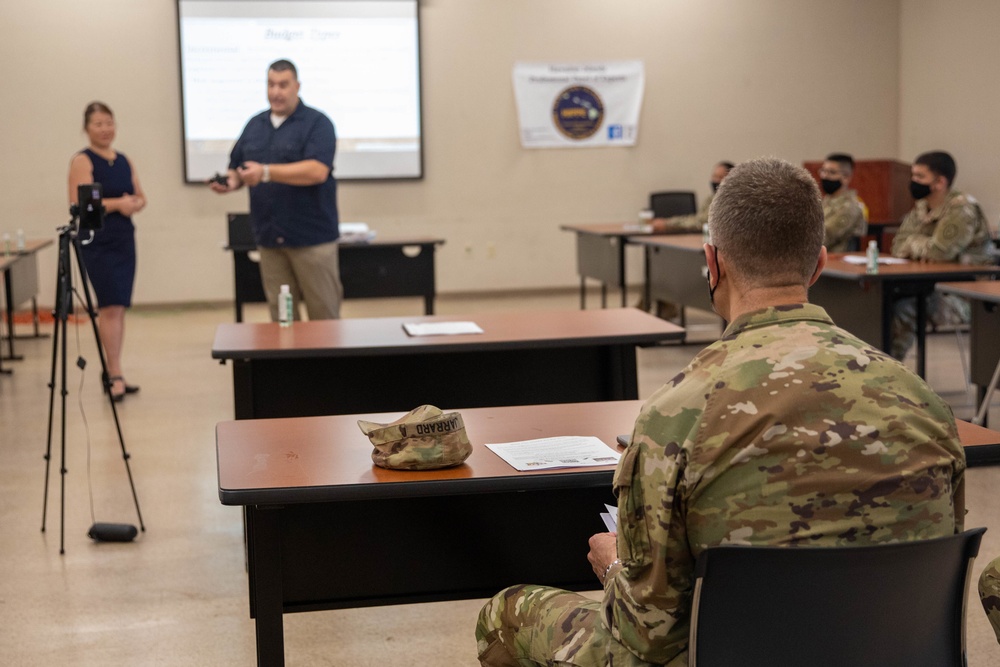
A Fleet and Family Support Center financial educator speaks with a participant about saving for emergencies during Military Saves Week. U.S. Navy photo by MC3 Jared Aldape, DVIDS (public domain).
Upload your Leave & Earnings Statement and get a plain-English breakdown of every line.
Open LES Tool→An emergency fund is cash you set aside for the stuff that always breaks: a tire, a phone, a car repair. It is what keeps one bad day from turning into a payday loan.
You do not need to be rich, or feel ready. Start with $500 to $1,000, keep it in a separate account, and make the saving automatic so you never have to decide.
Land a small starter first. Make saving automatic so it never depends on willpower. Then point the same transfer at a bigger cushion.
Your targets
Example assumes about $2,000 a month in essential expenses. Yours will differ.
Small and consistent beats big and someday. Start the starter, then climb.
Source: DoD Office of Financial Readiness (FINRED) · CFPB · figures illustrative
Six months of expenses is a huge number, big enough to make you quit before you begin. So do not aim there yet. A $500 to $1,000 starter covers most of the everyday emergencies that would otherwise land on a credit card.
Do not rely on willpower. Set a transfer for the day after payday, or use an allotment, which is money pulled straight from your pay before it ever reaches your bank. What you do not see, you do not spend. Treat that transfer like rent: it is not optional.
Park the money in its own savings account, away from the checking you spend from. Keep it reachable, meaning you can pull it in a day or two with no penalty. That rules out tying it up in investments, which can drop in value right when you need the cash. A plain savings account is fine. One that earns interest is better.
Once the starter is set, point the same transfer at the bigger goal: three to six months of essential expenses, like housing, food, insurance, and transportation. Lean toward the higher end if your life moves a lot. You do not have to get there fast, just steadily.
Military life moves, and your pay moves with it. The cushion sits between an everyday surprise and a predatory lender right outside the gate.
$400
A large share of U.S. adults can't cover a surprise $400 expense from savings.
No cushion: The $400 repair goes on a credit card or a title loan. One bad day becomes months of interest.
$1,000 starter: Paid straight from savings. $0 borrowed. You refill it over the next couple of paychecks and move on.
Why it hits different in uniform
Financial readiness is part of mission readiness. The fund is the wall.
Source: Federal Reserve (SHED) · Military OneSource · CFPB · figures illustrative
You do not have to figure this out alone. Every active-duty, Guard, and reserve member, and their family, can sit down with a Personal Financial Counselor at no cost to build a savings plan. You will find counselors and free spending-plan tools through Military OneSource, the DoD Office of Financial Readiness, and the CFPB. All three are linked in Sources below.
How much should I save first?
A starter fund of $500 to $1,000. Then build toward three to six months of essential expenses.
Where should I keep it?
A separate savings account you can reach in a day or two without a penalty. Not your everyday checking, and not an investment account that can lose value.
How do I find money to save on junior enlisted pay?
Start tiny and automatic, even $25 a payday. Then send any windfall, like a tax refund, a bonus, or a raise, straight to savings instead of spending it.







Comments
Share your experience or ask a question. Comments are reviewed by our team before they appear.
Leave a comment