VetraFi is a financial technology company, not an FDIC-insured bank. Banking services provided through our Banking Partner, Member FDIC.
Financial Readiness
A new 2026 feature moves traditional TSP money to Roth, but you pay tax now.
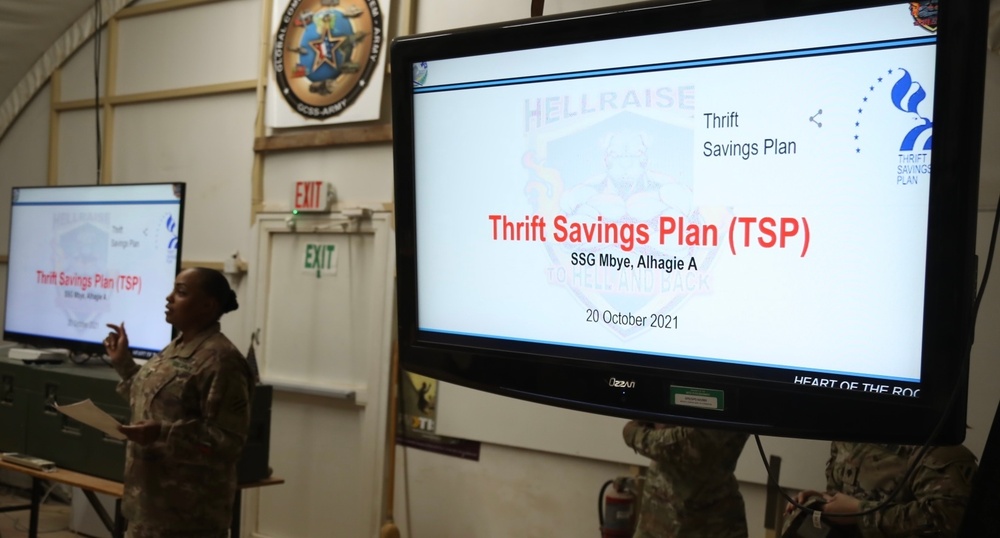
A Thrift Savings Plan class at Camp Arifjan, Kuwait. U.S. Army photo by Sgt. Marquis Hopkins, DVIDS (public domain).
Upload your Leave & Earnings Statement and get a plain-English breakdown of every line.
Open LES Tool→The short version
Starting in 2026, the Thrift Savings Plan lets you move money from your traditional (pre-tax) balance into your Roth (after-tax) balance without leaving the plan. It is called a Roth in-plan conversion. The catch: the amount you convert counts as taxable income for that year, and the TSP does not withhold the tax for you, so plan to cover it from other money. Conversions are irrevocable, and the TSP recommends talking to a tax advisor first.
Source: Thrift Savings Plan
It is a way to turn traditional TSP dollars into Roth TSP dollars inside your existing account. Before 2026, the only way to build a Roth balance was to contribute new Roth pay or roll in outside Roth funds. As of late January 2026, participants and spousal beneficiaries can convert an existing traditional balance to Roth directly in My Account.
Traditional TSP money is pre-tax: you did not pay income tax when it went in, so you pay tax when it comes out. Roth TSP money is the reverse: you already paid tax, so qualified withdrawals in retirement come out tax-free. A conversion moves money from the first bucket to the second, and the government collects the income tax on the way.
Source: Thrift Savings Plan
Active and separated participants with a total eligible vested balance of at least $500 can request a conversion. You also keep at least $500 (a "leave behind amount") in each non-Roth payroll source, such as your Traditional, tax-exempt, Automatic 1%, and Agency or Service Match sources, so the plan can handle any later payroll corrections. Spousal beneficiaries need a $500 balance and are not subject to the leave behind amount.
No income limit applies to a TSP Roth in-plan conversion. Unlike a Roth IRA, where higher earners get phased out, a participant with an eligible traditional balance can convert regardless of income.
Source: Thrift Savings Plan
The amount you convert is added to your taxable income for the year and taxed at your income tax rate. The TSP issues a Form 1099-R the following January showing the conversion, and it does not withhold taxes from the converted amount, so plan to pay the tax from other funds, not from the money that moved. Converting in a year when your taxable income is lower, for example a year with months of tax-exempt combat zone pay, can mean a smaller tax bill on the same conversion.
Source: Thrift Savings Plan
The common reason is tax timing. If you expect to be in a higher tax bracket later, paying tax now at a lower rate can leave more of your retirement money growing tax-free. Junior enlisted years, deployment years with the combat zone tax exclusion, and other low-income years are when your rate may be at its lowest. Converting some traditional balance in those years locks in today's rate. This is a personal call that depends on your bracket now versus later, the same question at the heart of the Roth versus traditional TSP decision, which is why the TSP recommends talking to a tax advisor before you convert.
Source: Thrift Savings Plan
A few rules to know:
Source: Thrift Savings Plan
Can I undo a TSP Roth conversion if I change my mind?
No. Roth in-plan conversions are irrevocable once processed, per IRS rules, so treat the decision as final and size it to what you can cover in taxes.
Does converting cost me anything up front?
There is no fee to convert, but the converted amount is added to your taxable income for the year, and the TSP does not withhold the tax, so plan to pay it from other money.
Is there an income limit like there is for a Roth IRA?
No income limit applies to a TSP Roth in-plan conversion. A participant with an eligible traditional balance can convert regardless of income.
How many times can I convert in a year?
Up to 26 conversions per account per calendar year, with a $500 minimum each.
Does a conversion change my regular TSP contributions or match?
No. A conversion only moves existing balances. Your contribution elections, your annual contribution limit, and your match continue as before.
What tax form do I get?
The TSP issues a Form 1099-R the following January for the conversion, with a distribution code of G. The conversion does not affect your W-2.
Should I convert my combat zone tax-exempt contributions?
Tax-exempt traditional contributions are a special case, and the mechanics differ by source, so this is a good question for a tax advisor and the TSP before you act. In general, converting during a low-income or tax-exempt year can reduce the tax hit, but the right move depends on your full picture.
VetraFi does not provide financial, investment, tax, legal, or accounting advice. The content provided is for informational purposes only. You should consult your own advisors before engaging in any transaction.
Earn It.
Important Disclosures
1. Banking Services. VetraFi is a financial technology company, not a bank. Banking services provided by First Bank of the Lake, Member FDIC.
2. FDIC Insurance. Deposits are held at First Bank of the Lake and are eligible for pass-through FDIC insurance up to $250,000 per depositor, per ownership category, if requirements for pass-through coverage are met. FDIC insurance applies only if the FDIC-insured bank fails.
3. Card Issuance. The VetraFi Shield Card is issued by First Bank of the Lake, pursuant to license from Mastercard International Incorporated. Cardholder terms and limitations apply. Mastercard and the circles design are registered trademarks of Mastercard International Incorporated.
4. Account Fees. The fees applicable to your accounts are disclosed in the respective account agreement for the account. Each of the account agreements are available at www.vetrafi.com/legal.
5. Credit Limit and Approval. The Shield Card is a secured charge card. Your credit limit is based on the amount of eligible funds in your deposit account and may increase or decrease as that balance changes. Funds securing your credit obligations are not available for withdrawal or transfer. Terms and conditions apply. See VetraFi Secured Charge Card Agreement.
6. APY. APY means Annual Percentage Yield. APY is accurate as of 09/15/2026. Minimum deposit required to open a Savings Account is $0. Interest rates and APY are subject to change at any time without notice. Fees could reduce the earnings on Saving Account. Funds must be held in Savings Account to earn interest. Other terms apply. See VetraFi Savings Account Agreement for details.
7. Early Access to Direct Deposit. Early access to direct deposit is available for eligible account holders that set up a direct deposit with their employer or paying agency. Early access to direct deposit funds is subject to when First Bank of the Lake receives notice of payment from the payer, which is generally one to two days before the scheduled payment date. Early access to direct deposit funds is not guaranteed, may be stopped at any time, and may vary between pay periods. Direct Deposit is only available for the Secured Deposit Account. Terms and conditions apply.
8. ATM and Fee Policy. VetraFi does not maintain a fee-free ATM network. Your card can be used at any ATM where Mastercard is accepted. ATM operators may charge a fee for cash advances. VetraFi will reimburse up to $15 per month or 4 fees per statement cycle for eligible fees; limits and conditions apply.
9. Non-Advice. VetraFi does not provide financial, investment, tax, legal, or accounting advice. The content provided is for informational purposes only. You should consult your own financial, investment, tax, legal, and accounting advisors before engaging in any transaction.
10. ATM Limits. ATM cash advance limits apply. See Secured Charge Card Agreement for details.
11. Account Terms. This Shield Card Account is opened together with a separate Secured Deposit Account and a Savings Account. See agreements available at www.vetrafi.com/legal for full terms and conditions.
12. Autopay. Autopay enrollment authorizes automatic payments from your Secured Deposit Account to pay the Shield Card balance due. You remain responsible for ensuring sufficient funds are available in the Secured Deposit Account and for making any required payment if autopay is not completed.
13. Credit Inquiries. Opening a VetraFi account does not result in a credit inquiry. Your Shield Card credit limit is based on the amount of eligible funds in your deposit account, not on a review of your creditworthiness. To open an account we must verify your identity, which may include obtaining information from consumer reporting agencies. Account opening is subject to identity verification and approval. Terms and conditions apply.
14. Subject to Approval. Products and services offered through VetraFi are subject to approval. Terms and conditions apply. See agreements available at www.vetrafi.com/legal for full terms and conditions.
15. Mastercard Zero Liability. You will not be held responsible for unauthorized transactions, including purchases made in store, by phone, online, or via mobile device, and ATM transactions, provided you used reasonable care in protecting your card from loss or theft and promptly reported any loss or theft to us. Zero Liability does not apply to certain commercial cards or unregistered prepaid cards. More information can be found at mastercard.com.
16. Third-Party Trademarks. All third-party trademarks, service marks, and logos are the property of their respective owners and are used for informational purposes only; no endorsement is implied. APPLE and the Apple logo are trademarks of Apple Inc. GOOGLE PLAY and the Google Play logo are trademarks of Google LLC. Mastercard is a registered trademark of Mastercard International Incorporated. Plaid is a trademark of Plaid Inc.
17. Non-Endorsement. The appearance of U.S. Department of Defense visual information does not imply or constitute Department of Defense endorsement.






Comments
Share your experience or ask a question. Comments are reviewed by our team before they appear.
Leave a comment