Financial Readiness
SGLI and TSP pay whoever's on the form. This 15-minute fix protects who you love.
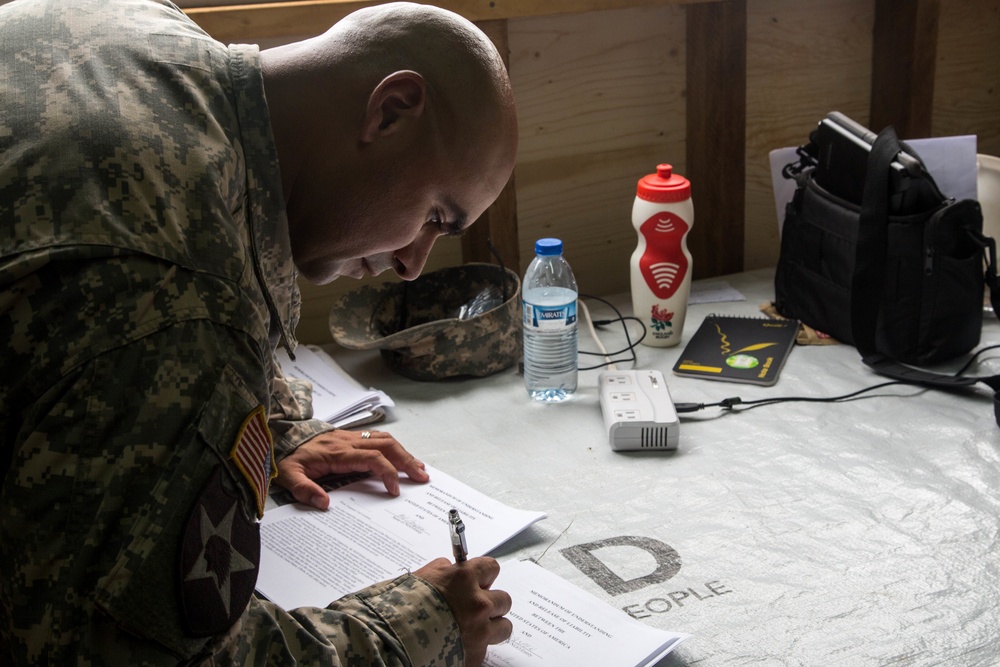
A Soldier completes official paperwork. U.S. Army photo by Spc. Rashene Mincy, 55th Signal Company, DVIDS (public domain).
Upload your Leave & Earnings Statement and get a plain-English breakdown of every line.
Open LES Tool→Two of your biggest assets in uniform are your SGLI (your military life insurance, worth up to $500,000) and your TSP (your military retirement account). Each one pays the person you named on its form. That person is called the beneficiary, the one the money pays out to. It does not automatically update to your spouse if you have an old form on file, and your will does not control it. The named beneficiary gets paid.
You update SGLI through SOES, the SGLI Online Enrollment System on milConnect. You update TSP in My Account on TSP.gov. If you have had any life change and have not checked these, do it this week.
Both SGLI and TSP pay the person named on their own form. Get those forms right, name a back-up, and check them once a year. Here is the whole job on one page.
The trap to avoid
A divorce does not fix it: A divorce decree does NOT change your TSP form. If you do not file a new designation, your TSP pays the person on the record, even an ex who waived their rights.
Your will cannot override these. Both pay the named beneficiary, period.
Picture the worst case. Something happens to you downrange. Your family is grieving, and now they need that half-million-dollar SGLI payout to keep the lights on. If your beneficiary form still lists a parent from basic training, or an ex you split with two years ago, that is who the money goes to. The system does exactly what the form says.
This is not a maybe. TSP states it plainly: they pay the beneficiary on file, and they cannot honor a will or any other document. SGLI works the same way. The form wins. So the form has to be right.
Use SOES, the SGLI Online Enrollment System, which lives on the milConnect portal. Log in with your CAC or myAuth, and you can name or update your beneficiaries, change your coverage amount, or adjust spouse coverage, all in one place. For full-time SGLI, SOES is the system of record, so the paper SGLV 8286 form is mostly retired.
While you are in there, know what you are working with. You are automatically covered at the $500,000 maximum, in $50,000 steps, unless you choose less. As of July 1, 2025, the premium dropped to 5 cents per $1,000 per month, so the maximum runs about $25 a month, plus $1 for Traumatic Injury Protection (TSGLI), for about $26 total out of your base pay. That is cheap coverage. The price is not the problem, leaving the wrong name on it is.
Whoever you designated, period. Log in to My Account on TSP.gov and use the beneficiary tool to name a person, your estate, or a trust. The online tool is faster and less error-prone than the paper TSP-3 form. You can name primary beneficiaries and back-up (contingent) beneficiaries, so if your first choice is gone, the money still lands where you want.
Here is the part that surprises people. If you divorce, and even if you remarry, but you do not file a new designation, your TSP pays the person still on the record, even if that ex gave up all rights to the account. A divorce decree does not fix your TSP form. Only a new designation does.
If you never name a beneficiary, a fixed legal order takes over, and it may not match your family. A few life events are your signal to log in and check both forms. If your family does not fit that fixed order (an unadopted stepchild, a blended family), naming beneficiaries yourself is the only way to control where the money goes.
No beneficiary named?
The fixed order: TSP follows a fixed order: spouse, then children, then parents, then estate. A stepchild you have not adopted does not count.
Triggers to log in
It is the most important 15 minutes of paperwork you will do.
Both are triggers to log in and check. A new spouse, a new child, an adoption, a divorce, or the death of someone you named: each one is a reason to review SGLI and TSP and update if needed. Set a reminder to glance at both once a year. It costs nothing and takes a few minutes. For more on the SGLI policy itself, see VetraFi's SGLI guide.
How do I change my SGLI beneficiary?
Log in to SOES, the SGLI Online Enrollment System on milConnect, with your CAC or myAuth, and update your beneficiary there.
Who gets my TSP if I die?
The beneficiary on file at TSP. They cannot pay based on a will. If you named no one, it follows the legal order: spouse, then children, then parents, then estate.
Does my will control my SGLI and TSP?
No. Both pay the beneficiary designation on file, not your will. That is why keeping the designation current matters so much.
I got divorced. Is my ex automatically off my TSP?
No. If you do not file a new designation, your TSP pays the person on the record, even an ex who waived their rights. File a new one to change it.
How much SGLI do I have and what does it cost?
Most members are automatically covered at $500,000. Since July 1, 2025, that costs about $25 a month plus $1 for TSGLI, so about $26 total.
Can I name more than one person?
Yes. You can split among multiple beneficiaries and add back-ups (contingents) in case your first choice passes before you do.
milConnect (SOES) lets you update SGLI coverage and beneficiaries. TSP.gov My Account lets you update TSP beneficiaries online, and the ThriftLine is 877-968-3778. Your unit S1 or personnel office can confirm your SGLI election and help if SOES gives you trouble. Base legal assistance is free if your situation is complicated, like a blended family, an estate, or naming a trust as beneficiary. For SOES questions, DMDC is at 800-368-3665.










Comments
Share your experience or ask a question. Comments are reviewed by our team before they appear.
Leave a comment