Pay & Entitlements
Base pay is your check's taxable core, rising with rank, time, and most-year raises.

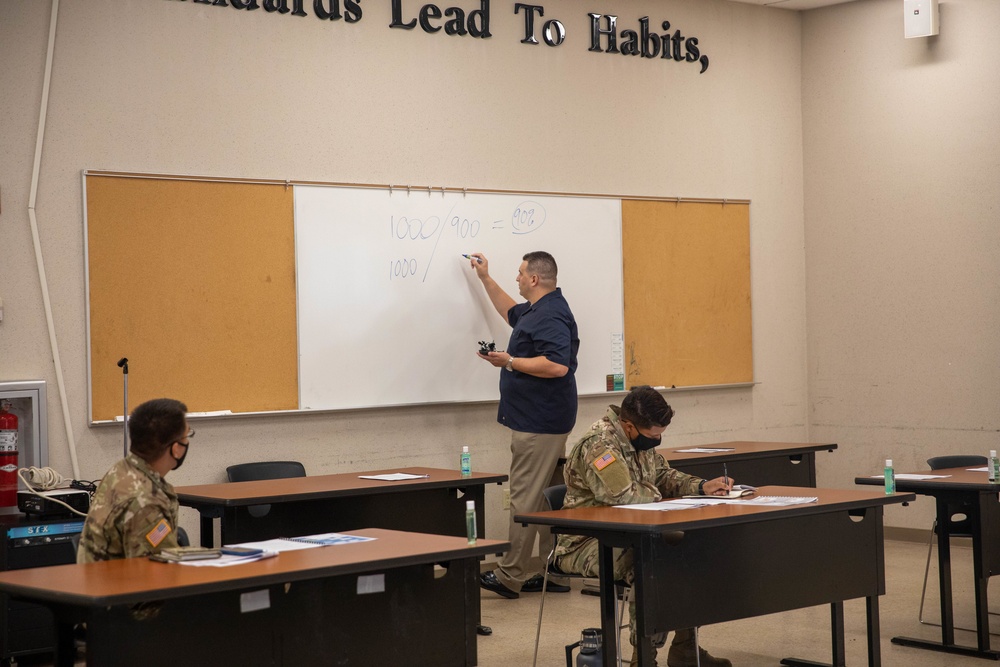
Army Military Pay Office staff train on military pay at USAFMCOM headquarters, Indianapolis, March 2026. U.S. Army photo by Mark R. W. Orders-Woempner, DVIDS (public domain).
Upload your Leave & Earnings Statement and get a plain-English breakdown of every line.
Open LES Tool→The pay table is a grid. Rows are pay grades (E-1 up through E-9 for enlisted). Columns are your cumulative years of service. Your monthly base pay is the cell where your row meets your column.
Base pay (the taxable core of your check) is one piece of what you earn. It moves with your rank and your years of service, and most years it gets an across-the-board raise in January.
Find your row, find your column, and the cell where they meet is your monthly base pay.
How to read it: Rows are pay grades (E-1 to E-9), columns are total creditable years of service. Your monthly base pay is the cell where they meet. Base pay is taxable; BAH and BAS are not.
2026 junior enlisted base pay
Monthly, gross, before deductions. Confirm your exact cell on your LES.
Three ways to a raise: promotion, crossing a years-of-service step, and the annual January raise.
Source: DFAS
Two things trip people up. First, the column is your total creditable years of service for pay, not time in your current rank. Second, base pay is the taxable part of your check, unlike BAH (the housing allowance) and BAS (the food allowance), which are not taxed.
Those monthly figures are gross pay, meaning everything before taxes and deductions come out. Always confirm your exact cell against your LES, the Leave and Earnings Statement that is your military pay stub.
Say you are an E-3 with two years of service or less. For 2026, you earn $2,836.80 a month, rising to $3,198.00 a month once you pass three years of service.
An E-4 starts at $3,142.20 a month at two years or less, and climbs to $3,815.40 once you pass six years. An E-1 with four or more months of service earns $2,407.20 a month, while an E-1 with less than four months earns $2,225.70. The E-2 rate is $2,697.90 a month, flat across every years-of-service column.
Three ways. You get a raise when you promote to a higher grade, when you cross a years-of-service step in your column, and through the across-the-board annual raise each January. Most people only track the first one and leave the other two as nice surprises.
Here is why the January raise matters, and what it does not change.
The annual raise lifts the whole table, but a few things about your pay stay the same when you move from basic training to your first station.
3.8%
the 2026 across-the-board base pay raise, effective Jan 1, 2026. Quick estimate: multiply your current base pay by 1.038.
Know this
The new rate shows up on your January LES once DFAS runs the first pay cycle.
Source: DFAS
No. You draw the same base pay for your grade in basic training that you draw at your first duty station. An E-1 earns the E-1 rate whether you are at reception, in basic, or in your first unit. The one wrinkle: an E-1 with less than four months of service draws a slightly lower rate, $2,225.70 a month, and steps up to $2,407.20 once you hit four months. Your allowances are what tend to shift between basic and your first station, not your base pay.
Base pay is one line. Gross pay is everything you earn before deductions: base pay plus your allowances and any special pays. Your take-home is gross pay minus taxes, FICA, SGLI, and your other deductions.
No. Enlisted (E), warrant officer (W), and commissioned officer (O) each have their own table, and the 3.8 percent 2026 raise applies across all of them. The same base pay table also sets drill pay for Guard and Reserve members, so the 3.8 percent raise flows into drill and annual training pay too.
On the DFAS site under Pay Tables. DFAS posts the current-year basic pay charts for enlisted, warrant, and commissioned grades, and updates them each January. The annual raise is tied by law to the Employment Cost Index, which tracks private-sector wage growth, unless Congress sets a different number. For 2026, Congress set it at 3.8 percent in the FY2026 National Defense Authorization Act, effective January 1, 2026.
Start with your servicing finance or disbursing office (S-1, admin, or the base finance office) for anything specific to your pay account. You can also reach DFAS customer service at 1-888-332-7411, or use askDFAS for pay-record questions, and view your LES, tax withholding, allotments, and TSP in MyPay.
For free counseling, every service member and family can use Military OneSource 24/7, and your installation's Personal Financial Management program offers free in-person help through Army Community Service, Fleet and Family Support, Airman and Family Readiness, or Marine Corps Community Services.
How much is E-4 base pay in 2026?
An E-4 earns from $3,142.20 a month at two years or less, up to $3,815.40 a month at over six years, depending on your years of service.
Does the annual raise apply to Guard and Reserve?
Yes. The same base pay table sets drill pay, so the 3.8 percent 2026 raise flows into drill and annual training pay too.
When will the new rate show up?
On your January LES, once DFAS processes the first pay cycle of the year.







Comments
Share your experience or ask a question. Comments are reviewed by our team before they appear.
Leave a comment