VetraFi is a financial technology company, not an FDIC-insured bank. Banking services provided through our Banking Partner, Member FDIC.
Guard & Reserve
Same uniform on the drill floor, two chains of command on paper, and the authority line on your orders decides the rest.
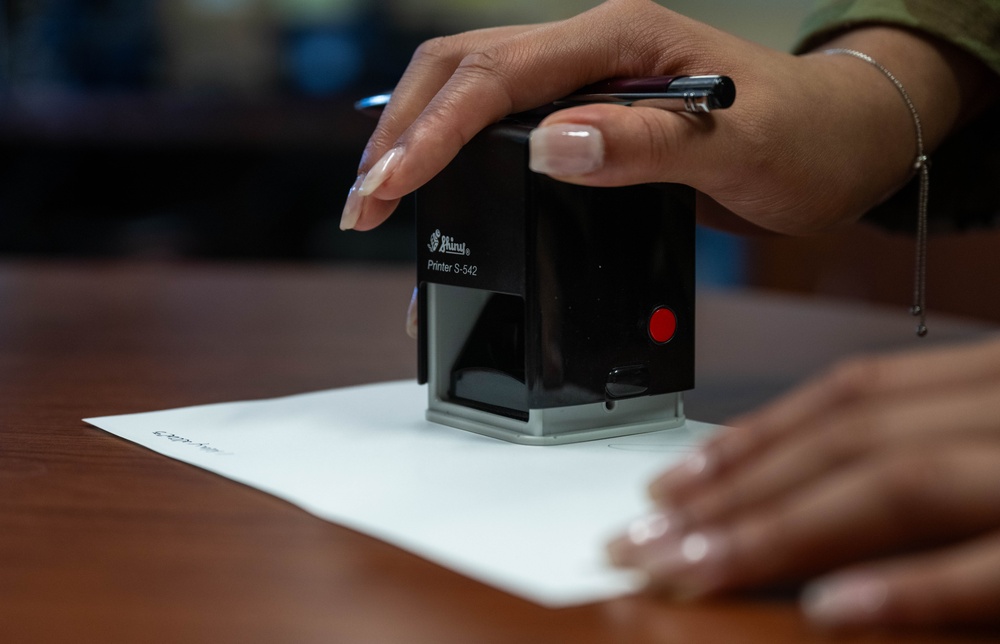
An Army National Guard human resources NCO hands documents to a Soldier at a Soldier Readiness Processing site. U.S. Army National Guard photo by Staff Sgt. Katie Mazos-Vega, Fort Riley, Kansas, DVIDS (public domain).
Upload your Leave & Earnings Statement and get a plain-English breakdown of every line.
Open LES Tool→Guard and Reserve look identical on the drill floor. The difference sits on paper. A Guard member holds two memberships at once, one state and one federal, so a governor can put Guard troops on state orders, while a Reserve member holds only the federal one. The authority line on your orders, the part citing Title 10, Title 32, or state law, drives your pay, your health care, your job protection, and whether that time counts toward being a veteran.
The Guard answers to a governor and to the President. The Reserve answers only to the federal side.
Federal law names seven reserve components. Only the Army and the Air Force have Guard components, so Navy, Marine Corps, and Coast Guard drillers are in a Reserve component.
Same uniform on the drill floor. Two chains of command on paper.
Source: 10 U.S.C. 10101 and 32 U.S.C. 101
Title 10, Title 32, and State Active Duty.
Title 10 and Title 32 pay comes from DFAS off the federal pay tables, and you can read it in myPay on your LES. State Active Duty comes out of the state treasury at a state-set rate, which can look nothing like your drill check. See Drill Pay and State Active Duty.
Source: National Guard Bureau
Find the citation naming the law the duty is issued under, then find the period of duty.
A Title 10 section means federal active duty. Title 32 means federal money under state command. A state statute means state orders. If you cannot find it, ask the S-1 shop or your readiness NCO for a clean copy, then save a PDF. Years later, a claim or a pay audit can turn on a document nobody else kept.
Keep every set of orders. The paper outlives the mission.
Benefits switch on at that line, and the test is what the order says, not how many days you serve.
The law defines active duty for a period of more than 30 days as active duty under a call or order that does not specify a period of 30 days or less. An order specifying 45 days that gets cut short on day 20 was still an order for more than 30 days, and an open-ended order with no period specified also qualifies.
When long orders land, the money changes shape fast. Activation Money covers what starts and what stops.
Source: 10 U.S.C. 101(d)(2), 37 U.S.C. 403(g), and DoD Military Compensation
Federal statuses generally build your record. State Active Duty generally does not.
Title 32 full-time service under sections 316, 502, 503, 504, and 505 earns retirement points. Service in a non-federally-recognized status in the National Guard, which is what State Active Duty is, does not.
Long federal orders can also buy back time. Qualifying active duty after January 28, 2008 can cut the age-60 reserve retirement age by 3 months for each cumulative 90 days in a fiscal year, and since September 30, 2014 days can be combined across two consecutive fiscal years, each day counted once. The age cannot go below 50. Drill, annual training, and active duty for training do not qualify. See Reserve Retirement Points.
Source: 10 U.S.C. 12732 and 10 U.S.C. 12731(f)
Generally it takes Title 10 non-training active duty. Read this part twice.
Federal law classifies full-time Title 32 duty as active duty for training, not active duty. That training time counts as qualifying service only if the member was disabled or died from a disease or injury incurred or aggravated in line of duty during it. So Title 32 alone generally does not make you a veteran for VA purposes, no matter how operational the mission felt. VA also states that State Active Duty is based on state law and funding and does not qualify as active duty for VA benefits.
Do not collapse two questions. Veteran status is one. Specific benefits are another, and some attach to Guard service on their own terms. Guard members can qualify for the VA home loan benefit with not less than 90 cumulative days of full-time National Guard duty, at least 30 of them consecutive. Monthly drills and initial training do not count toward it.
Not a veteran yet does not mean you are earning nothing.
Source: 38 U.S.C. 101, VA, and VA Home Loan Eligibility
Job protection reaches further than the interest-rate protections do, and both track the status on your orders.
Two troops filling sandbags on the same levee can carry different protections. The paperwork tells them apart.
Source: 38 U.S.C. 4303(13) and 50 U.S.C. 3911(2)
Is the National Guard the same thing as the Reserves?
Not quite. Both are reserve components under federal law. The Guard adds a state membership, which is why a governor can activate the Guard and cannot activate the Reserve.
Am I a veteran if I did a hurricane mission with my Guard unit?
Generally not from that mission alone. Full-time Title 32 duty counts as active duty for training for VA purposes, and State Active Duty does not qualify as active duty for VA benefits.
Why is my BAH so low on these orders?
Check the length. Orders of 30 days or less generally pay BAH-RC, a flat rate that does not vary by location, unless the orders support a contingency operation.
My orders got cut short at day 20. Did I lose the more than 30 days benefits?
The test looks at what the order specified, not how many days you served.
Does state duty count toward my 20 year letter?
A non-federally-recognized status in the National Guard earns no retirement points. Title 32 full-time duty under the listed sections does.
Who do I call when my activation pay is wrong?
Start with your S-1 or readiness NCO, orders in hand, then DFAS for the pay record.
My spouse is on orders. When does our TRICARE start?
Family coverage generally begins on the first day of orders when the orders are for active duty for more than 30 days.
VetraFi does not provide financial, investment, tax, legal, or accounting advice. The content provided is for informational purposes only. You should consult your own advisors before engaging in any transaction.
Earn It.
Important Disclosures
1. Banking Services. VetraFi is a financial technology company, not a bank. Banking services provided by First Bank of the Lake, Member FDIC.
2. FDIC Insurance. Deposits are held at First Bank of the Lake and are eligible for pass-through FDIC insurance up to $250,000 per depositor, per ownership category, if requirements for pass-through coverage are met. FDIC insurance applies only if the FDIC-insured bank fails.
3. Card Issuance. The VetraFi Shield Card is issued by First Bank of the Lake, pursuant to license from Mastercard International Incorporated. Cardholder terms and limitations apply. Mastercard and the circles design are registered trademarks of Mastercard International Incorporated.
4. Account Fees. The fees applicable to your accounts are disclosed in the respective account agreement for the account. Each of the account agreements are available at www.vetrafi.com/legal.
5. Credit Limit and Approval. The Shield Card is a secured charge card. Your credit limit is based on the amount of eligible funds in your deposit account and may increase or decrease as that balance changes. Funds securing your credit obligations are not available for withdrawal or transfer. Terms and conditions apply. See VetraFi Secured Charge Card Agreement.
6. APY. APY means Annual Percentage Yield. APY is accurate as of 09/15/2026. Minimum deposit required to open a Savings Account is $0. Interest rates and APY are subject to change at any time without notice. Fees could reduce the earnings on Saving Account. Funds must be held in Savings Account to earn interest. Other terms apply. See VetraFi Savings Account Agreement for details.
7. Early Access to Direct Deposit. Early access to direct deposit is available for eligible account holders that set up a direct deposit with their employer or paying agency. Early access to direct deposit funds is subject to when First Bank of the Lake receives notice of payment from the payer, which is generally one to two days before the scheduled payment date. Early access to direct deposit funds is not guaranteed, may be stopped at any time, and may vary between pay periods. Direct Deposit is only available for the Secured Deposit Account. Terms and conditions apply.
8. ATM and Fee Policy. VetraFi does not maintain a fee-free ATM network. Your card can be used at any ATM where Mastercard is accepted. ATM operators may charge a fee for cash advances. VetraFi will reimburse up to $15 per month or 4 fees per statement cycle for eligible fees; limits and conditions apply.
9. Non-Advice. VetraFi does not provide financial, investment, tax, legal, or accounting advice. The content provided is for informational purposes only. You should consult your own financial, investment, tax, legal, and accounting advisors before engaging in any transaction.
10. ATM Limits. ATM cash advance limits apply. See Secured Charge Card Agreement for details.
11. Account Terms. This Shield Card Account is opened together with a separate Secured Deposit Account and a Savings Account. See agreements available at www.vetrafi.com/legal for full terms and conditions.
12. Autopay. Autopay enrollment authorizes automatic payments from your Secured Deposit Account to pay the Shield Card balance due. You remain responsible for ensuring sufficient funds are available in the Secured Deposit Account and for making any required payment if autopay is not completed.
13. Credit Inquiries. Opening a VetraFi account does not result in a credit inquiry. Your Shield Card credit limit is based on the amount of eligible funds in your deposit account, not on a review of your creditworthiness. To open an account we must verify your identity, which may include obtaining information from consumer reporting agencies. Account opening is subject to identity verification and approval. Terms and conditions apply.
14. Subject to Approval. Products and services offered through VetraFi are subject to approval. Terms and conditions apply. See agreements available at www.vetrafi.com/legal for full terms and conditions.
15. Mastercard Zero Liability. You will not be held responsible for unauthorized transactions, including purchases made in store, by phone, online, or via mobile device, and ATM transactions, provided you used reasonable care in protecting your card from loss or theft and promptly reported any loss or theft to us. Zero Liability does not apply to certain commercial cards or unregistered prepaid cards. More information can be found at mastercard.com.
16. Third-Party Trademarks. All third-party trademarks, service marks, and logos are the property of their respective owners and are used for informational purposes only; no endorsement is implied. APPLE and the Apple logo are trademarks of Apple Inc. GOOGLE PLAY and the Google Play logo are trademarks of Google LLC. Mastercard is a registered trademark of Mastercard International Incorporated. Plaid is a trademark of Plaid Inc.
17. Non-Endorsement. The appearance of U.S. Department of Defense visual information does not imply or constitute Department of Defense endorsement.









Comments
Share your experience or ask a question. Comments are reviewed by our team before they appear.
Leave a comment