VetraFi is a financial technology company, not an FDIC-insured bank. Banking services provided through our Banking Partner, Member FDIC.
Guard & Reserve
For the 6 percent interest cap, the clock starts the day your orders were issued, not the day you report.
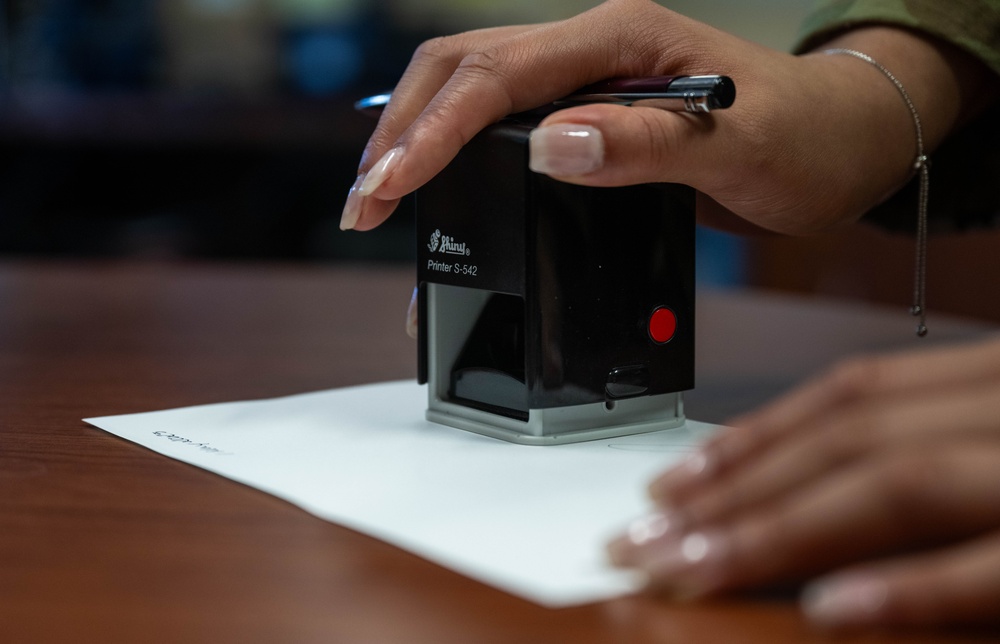
An Air Force paralegal notarizes a document for a service member during Legal Assistance Readiness Week. U.S. Air Force photo by Senior Airman Caroline Strickland, Honolulu, Hawaii, DVIDS (public domain).
Upload your Leave & Earnings Statement and get a plain-English breakdown of every line.
Open LES Tool→The federal SCRA does not switch on for every set of Guard or Reserve orders. It generally covers Title 10 active duty, and a Guard member called by the President or the Secretary of Defense for more than 30 consecutive days under 32 U.S.C. 502(f) to respond to a declared national emergency with federal funds. Most protections start the day you report. The 6 percent interest cap is the exception, because it runs from the date the orders were issued.
Title 10 counts. Drill weekend, annual training, and State Active Duty generally do not.
Open the orders packet and find the authority line. That line, not the mission, decides what you can claim. If you are fuzzy on status, start with duty status basics and State Active Duty.
Source: 50 U.S.C. 3911 and CFPB
It depends on the protection, and this split hits Guard and Reserve members hardest.
The orders date is money. The report date can be weeks late to the fight.
Source: Department of Justice
It caps the rate on debt you took on before entering military service, and it forgives the excess instead of parking it at the back of the loan.
You are not asking for a favor. You are giving notice.
More in the 6 percent cap explainer and Activation Money.
Source: Department of Justice
Send written notice, electronic counts, with proof of service, and hold the line if a call center says its database came back clean.
That last point matters here more than anywhere else, because Guard and Reserve records in that database are often incomplete or lagging. CFPB estimated per-activation savings of between $1,890 and $5,670 on mortgages, about $331 on auto loans, and about $249 on personal loans. From 2007 to 2018, fewer than 10 percent of auto loans and 6 percent of personal loans held by activated Guard and Reserve members got a reduced rate.
Source: Justice Department and CFPB and CFPB
Often the apartment, less often the car, and that mismatch is the trap.
A 90-day mobilization can end the apartment lease and leave the car lease running.
Mechanics are in breaking a lease on orders.
Source: 50 U.S.C. 3955
A court has to get involved before anyone takes the house, the apartment, or a judgment.
Leave your spouse a copy of the orders and a working address, because court paper can land in the mailbox of the apartment you are still paying for while you are gone. Your civilian job runs on a separate law, USERRA.
Source: Department of Justice and Federal Register
Orders issued in March, I report in May. When does the cap start?
The Justice Department states interest rate benefits begin the day orders to active duty are issued. Sending notice early can capture more of that window.
Does drill or annual training count?
Ordinary Title 32 drill and annual training generally do not trigger the federal SCRA, and neither does State Active Duty.
I deployed and came home. Am I too late?
Notice can be sent no later than 180 days after military service ends, and the benefit applies retroactively.
Does the cap cover the card I opened at the mob station?
No. It covers obligations incurred before you entered military service.
Can my spouse handle this while I am gone?
A spouse can gather the account list and mail the notices. A power of attorney often makes the rest easier, and legal assistance can explain what type fits your situation.
My state called me up for a flood. Does this apply?
The federal SCRA generally does not reach State Active Duty. Some states have their own protections, so ask legal assistance about your state.
VetraFi does not provide financial, investment, tax, legal, or accounting advice. The content provided is for informational purposes only. You should consult your own advisors before engaging in any transaction.
Earn It.
Important Disclosures
1. Banking Services. VetraFi is a financial technology company, not a bank. Banking services provided by First Bank of the Lake, Member FDIC.
2. FDIC Insurance. Deposits are held at First Bank of the Lake and are eligible for pass-through FDIC insurance up to $250,000 per depositor, per ownership category, if requirements for pass-through coverage are met. FDIC insurance applies only if the FDIC-insured bank fails.
3. Card Issuance. The VetraFi Shield Card is issued by First Bank of the Lake, pursuant to license from Mastercard International Incorporated. Cardholder terms and limitations apply. Mastercard and the circles design are registered trademarks of Mastercard International Incorporated.
4. Account Fees. The fees applicable to your accounts are disclosed in the respective account agreement for the account. Each of the account agreements are available at www.vetrafi.com/legal.
5. Credit Limit and Approval. The Shield Card is a secured charge card. Your credit limit is based on the amount of eligible funds in your deposit account and may increase or decrease as that balance changes. Funds securing your credit obligations are not available for withdrawal or transfer. Terms and conditions apply. See VetraFi Secured Charge Card Agreement.
6. APY. APY means Annual Percentage Yield. APY is accurate as of 09/15/2026. Minimum deposit required to open a Savings Account is $0. Interest rates and APY are subject to change at any time without notice. Fees could reduce the earnings on Saving Account. Funds must be held in Savings Account to earn interest. Other terms apply. See VetraFi Savings Account Agreement for details.
7. Early Access to Direct Deposit. Early access to direct deposit is available for eligible account holders that set up a direct deposit with their employer or paying agency. Early access to direct deposit funds is subject to when First Bank of the Lake receives notice of payment from the payer, which is generally one to two days before the scheduled payment date. Early access to direct deposit funds is not guaranteed, may be stopped at any time, and may vary between pay periods. Direct Deposit is only available for the Secured Deposit Account. Terms and conditions apply.
8. ATM and Fee Policy. VetraFi does not maintain a fee-free ATM network. Your card can be used at any ATM where Mastercard is accepted. ATM operators may charge a fee for cash advances. VetraFi will reimburse up to $15 per month or 4 fees per statement cycle for eligible fees; limits and conditions apply.
9. Non-Advice. VetraFi does not provide financial, investment, tax, legal, or accounting advice. The content provided is for informational purposes only. You should consult your own financial, investment, tax, legal, and accounting advisors before engaging in any transaction.
10. ATM Limits. ATM cash advance limits apply. See Secured Charge Card Agreement for details.
11. Account Terms. This Shield Card Account is opened together with a separate Secured Deposit Account and a Savings Account. See agreements available at www.vetrafi.com/legal for full terms and conditions.
12. Autopay. Autopay enrollment authorizes automatic payments from your Secured Deposit Account to pay the Shield Card balance due. You remain responsible for ensuring sufficient funds are available in the Secured Deposit Account and for making any required payment if autopay is not completed.
13. Credit Inquiries. Opening a VetraFi account does not result in a credit inquiry. Your Shield Card credit limit is based on the amount of eligible funds in your deposit account, not on a review of your creditworthiness. To open an account we must verify your identity, which may include obtaining information from consumer reporting agencies. Account opening is subject to identity verification and approval. Terms and conditions apply.
14. Subject to Approval. Products and services offered through VetraFi are subject to approval. Terms and conditions apply. See agreements available at www.vetrafi.com/legal for full terms and conditions.
15. Mastercard Zero Liability. You will not be held responsible for unauthorized transactions, including purchases made in store, by phone, online, or via mobile device, and ATM transactions, provided you used reasonable care in protecting your card from loss or theft and promptly reported any loss or theft to us. Zero Liability does not apply to certain commercial cards or unregistered prepaid cards. More information can be found at mastercard.com.
16. Third-Party Trademarks. All third-party trademarks, service marks, and logos are the property of their respective owners and are used for informational purposes only; no endorsement is implied. APPLE and the Apple logo are trademarks of Apple Inc. GOOGLE PLAY and the Google Play logo are trademarks of Google LLC. Mastercard is a registered trademark of Mastercard International Incorporated. Plaid is a trademark of Plaid Inc.
17. Non-Endorsement. The appearance of U.S. Department of Defense visual information does not imply or constitute Department of Defense endorsement.







Comments
Share your experience or ask a question. Comments are reviewed by our team before they appear.
Leave a comment