VetraFi is a financial technology company, not an FDIC-insured bank. Banking services provided through our Banking Partner, Member FDIC.
Guard & Reserve
Drill pay is a transaction your unit has to certify and process, not a salary, so build the month on the paycheck you can predict.
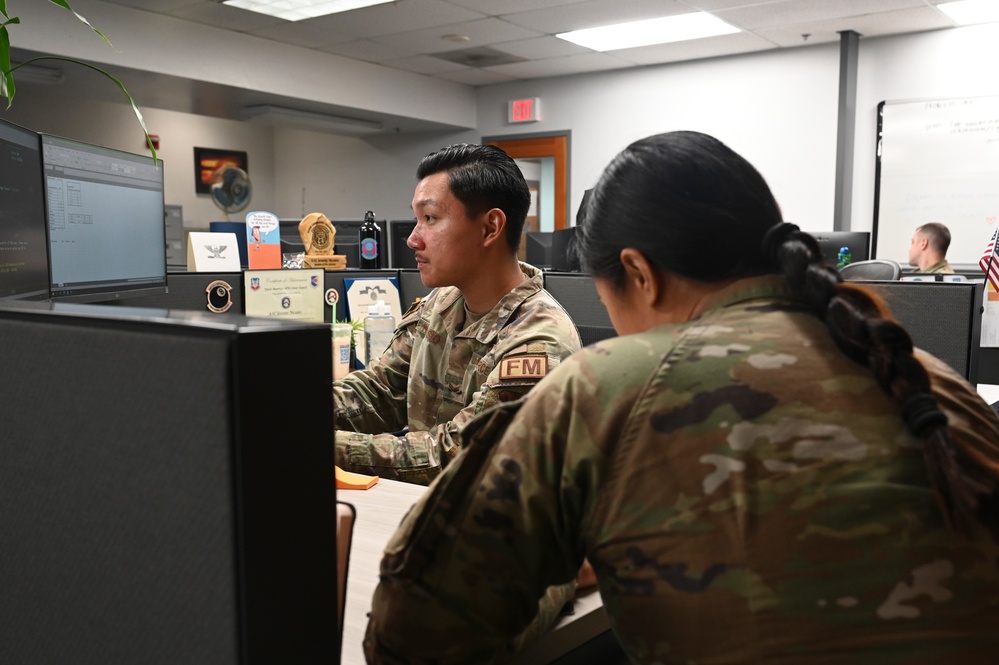
A financial operations technician assists a customer at the finance counter. U.S. Air Force photo by Airman 1st Class Devlin Bishop, Davis-Monthan Air Force Base, Arizona, DVIDS (public domain).
Upload your Leave & Earnings Statement and get a plain-English breakdown of every line.
Open LES Tool→Drill pay is not a salary. It is a transaction your unit certifies and pushes into the pay system, and if it misses the processing cutoff the money can land on the following payday, up to two weeks later. Guard and Reserve members ride the same two-paydays-a-month cycle as active duty, but in 2026 the end-of-month payday slides onto the 1st several times. Build the month on the civilian paycheck you can predict, and give drill pay a job before it lands.
Because signing in does not move money. Somebody at the unit certifies the duty, enters it, and beats a cutoff. The Army Reserve publishes real deadlines, which is rare. Other services do not publish an equivalent, so read these as Army Reserve figures only.
Late drill pay is usually a paperwork problem at the unit, not a bank problem.
Source: U.S. Army Reserve Finance Guide
Not exactly, and that alone can break a budget. DFAS runs Reserve Component members on the same mid-month and end-of-month cycle as active duty, with the LES posting to myPay roughly a week ahead. The catch is that the end-of-month payday often lands on the 1st.
That end-of-month payday slides to the 1st in March, April, May, June, August, September, and November 2026. If rent hits on the 1st, you are cutting it close before a single form goes missing.
Source: DFAS Reserve Paydays
Anything that starts the paperwork after the training. A regular drill weekend is the clean case, because the unit closes it out right behind the formation.
Less than most junior troops assume, which is why it should not be holding up rent. Pay runs by drill period, and a standard weekend is 4 periods.
That is gross, before taxes and TSP, and a normal drill weekend generally pays basic pay only, no BAH and no BAS. Over a year, members generally perform 48 scheduled drills plus annual training of not less than 14 days, or 12 for the Coast Guard Reserve, exclusive of travel. The arithmetic lives in Drill Pay, and the civilian W-2 collision is in Two Paychecks, One Tax Bill.
Source: DFAS Drill Pay Tables and DoD Instruction 1215.06
Because the Reserve Component LES does not carry them. DFAS states that Reservist and National Guard members do not have allotments, and fields 12 and 16 sit unused. Any automatic split has to happen on the civilian side or through your own transfer tools, as covered in Direct Deposit and Allotments.
Check the check date and the duty code, then match them to the weekends you worked. The Reserve Component LES is a 78-field, single-page statement covering entitlements, deductions, leave, tax withholding, and TSP.
Pull the LES on myPay about a week before payday. Walking into the S-1 with dates and a field number generally gets a faster answer than saying you did not get paid. Start with How to Read Your LES.
Source: DFAS Reserve and National Guard LES Guide
Put the fixed bills on the income you can predict, which for most drilling members is the civilian paycheck. Then a late drill payment is an annoyance instead of an overdraft. These are options, not orders.
No monthly plan yet? Start with First Budget on Military Pay and Track Your Spending.
I drilled last weekend and myPay shows nothing. Is something wrong?
Probably not yet, since the Army Reserve guide notes IDT payments normally occur within 10 days of duty performance.
Why did my RST take longer than a drill weekend?
The Army Reserve clock runs from receipt of the DA Form 1380, so a form that sits in an inbox pays late.
Do the 24 and 72 hour deadlines apply to my Air Guard or Navy Reserve unit?
Those come from the Army Reserve guide, and no DFAS-wide or other-service equivalent was located, so read them as a sense of the process, not a rule for your component.
Can I allot part of my drill pay to savings?
Generally no, since DFAS states Reserve and National Guard members do not have allotments. Set the transfer on the civilian side instead.
My annual training did not pay at all. What do I check first?
Check whether you signed the bottom of your orders, because unsigned orders can mean unpaid annual training.
Unit or DFAS?
Start at the unit. Almost every late drill payment is a paperwork problem at the S-1, not a DFAS problem.
VetraFi does not provide financial, investment, tax, legal, or accounting advice. The content provided is for informational purposes only. You should consult your own advisors before engaging in any transaction.
Earn It.
Important Disclosures
1. Banking Services. VetraFi is a financial technology company, not a bank. Banking services provided by First Bank of the Lake, Member FDIC.
2. FDIC Insurance. Deposits are held at First Bank of the Lake and are eligible for pass-through FDIC insurance up to $250,000 per depositor, per ownership category, if requirements for pass-through coverage are met. FDIC insurance applies only if the FDIC-insured bank fails.
3. Card Issuance. The VetraFi Shield Card is issued by First Bank of the Lake, pursuant to license from Mastercard International Incorporated. Cardholder terms and limitations apply. Mastercard and the circles design are registered trademarks of Mastercard International Incorporated.
4. Account Fees. The fees applicable to your accounts are disclosed in the respective account agreement for the account. Each of the account agreements are available at www.vetrafi.com/legal.
5. Credit Limit and Approval. The Shield Card is a secured charge card. Your credit limit is based on the amount of eligible funds in your deposit account and may increase or decrease as that balance changes. Funds securing your credit obligations are not available for withdrawal or transfer. Terms and conditions apply. See VetraFi Secured Charge Card Agreement.
6. APY. APY means Annual Percentage Yield. APY is accurate as of 09/15/2026. Minimum deposit required to open a Savings Account is $0. Interest rates and APY are subject to change at any time without notice. Fees could reduce the earnings on Saving Account. Funds must be held in Savings Account to earn interest. Other terms apply. See VetraFi Savings Account Agreement for details.
7. Early Access to Direct Deposit. Early access to direct deposit is available for eligible account holders that set up a direct deposit with their employer or paying agency. Early access to direct deposit funds is subject to when First Bank of the Lake receives notice of payment from the payer, which is generally one to two days before the scheduled payment date. Early access to direct deposit funds is not guaranteed, may be stopped at any time, and may vary between pay periods. Direct Deposit is only available for the Secured Deposit Account. Terms and conditions apply.
8. ATM and Fee Policy. VetraFi does not maintain a fee-free ATM network. Your card can be used at any ATM where Mastercard is accepted. ATM operators may charge a fee for cash advances. VetraFi will reimburse up to $15 per month or 4 fees per statement cycle for eligible fees; limits and conditions apply.
9. Non-Advice. VetraFi does not provide financial, investment, tax, legal, or accounting advice. The content provided is for informational purposes only. You should consult your own financial, investment, tax, legal, and accounting advisors before engaging in any transaction.
10. ATM Limits. ATM cash advance limits apply. See Secured Charge Card Agreement for details.
11. Account Terms. This Shield Card Account is opened together with a separate Secured Deposit Account and a Savings Account. See agreements available at www.vetrafi.com/legal for full terms and conditions.
12. Autopay. Autopay enrollment authorizes automatic payments from your Secured Deposit Account to pay the Shield Card balance due. You remain responsible for ensuring sufficient funds are available in the Secured Deposit Account and for making any required payment if autopay is not completed.
13. Credit Inquiries. Opening a VetraFi account does not result in a credit inquiry. Your Shield Card credit limit is based on the amount of eligible funds in your deposit account, not on a review of your creditworthiness. To open an account we must verify your identity, which may include obtaining information from consumer reporting agencies. Account opening is subject to identity verification and approval. Terms and conditions apply.
14. Subject to Approval. Products and services offered through VetraFi are subject to approval. Terms and conditions apply. See agreements available at www.vetrafi.com/legal for full terms and conditions.
15. Mastercard Zero Liability. You will not be held responsible for unauthorized transactions, including purchases made in store, by phone, online, or via mobile device, and ATM transactions, provided you used reasonable care in protecting your card from loss or theft and promptly reported any loss or theft to us. Zero Liability does not apply to certain commercial cards or unregistered prepaid cards. More information can be found at mastercard.com.
16. Third-Party Trademarks. All third-party trademarks, service marks, and logos are the property of their respective owners and are used for informational purposes only; no endorsement is implied. APPLE and the Apple logo are trademarks of Apple Inc. GOOGLE PLAY and the Google Play logo are trademarks of Google LLC. Mastercard is a registered trademark of Mastercard International Incorporated. Plaid is a trademark of Plaid Inc.
17. Non-Endorsement. The appearance of U.S. Department of Defense visual information does not imply or constitute Department of Defense endorsement.










Comments
Share your experience or ask a question. Comments are reviewed by our team before they appear.
Leave a comment